
Taylar Castellanos: Storytelling as Collective Power
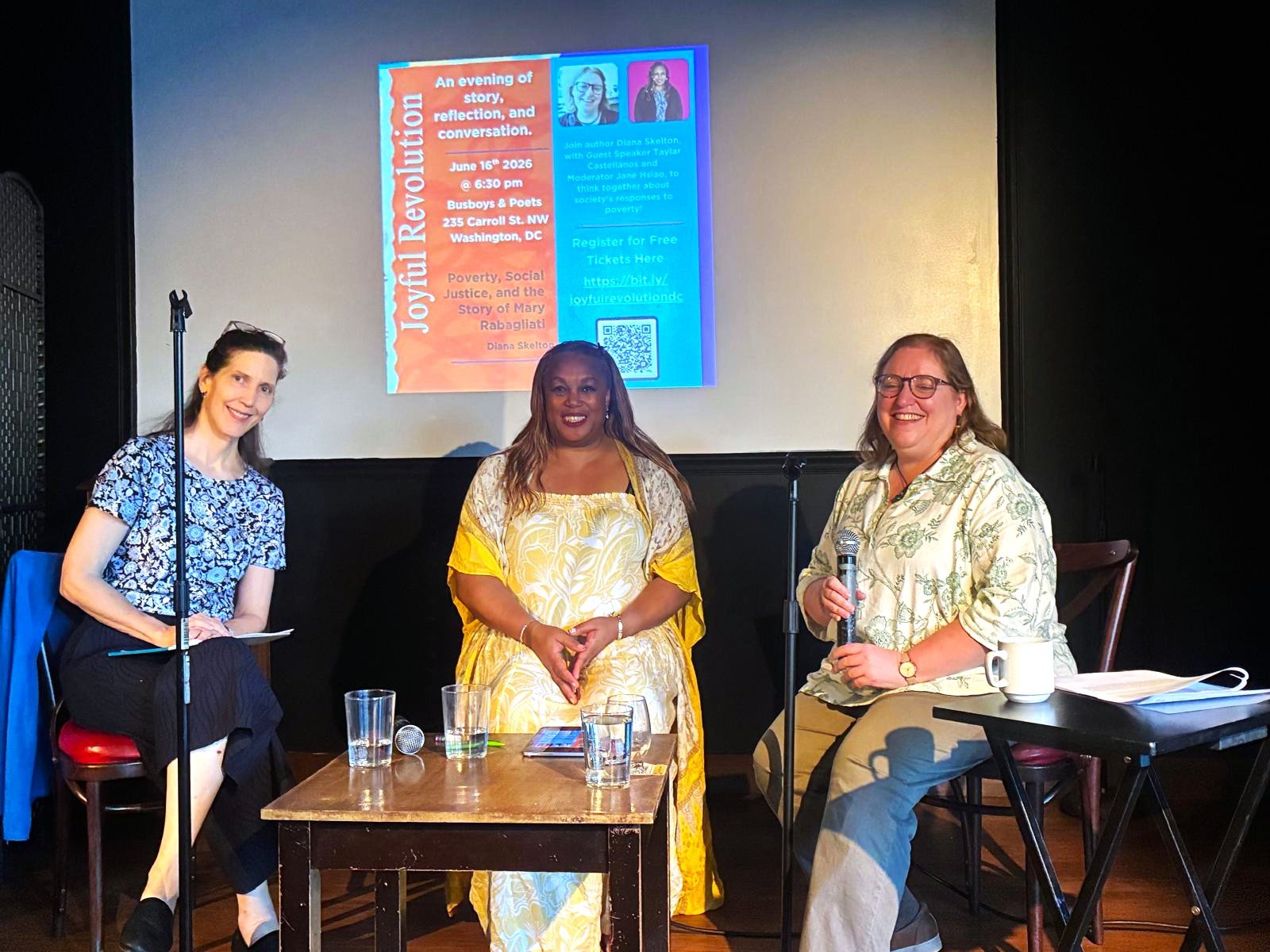
Taylar Castellanos (Middle) speaks at Busboys and Poets, with Author Diana Skelton (RIght) and moderator Jane Hsiao (Left)
Introduction
ATD Fourth World is committed to learning from people with lived experience of poverty and creating opportunities for them to tell their own stories. For that reason, ATD invited Taylar Castellanos to share her story at an event promoting Joyful Revolution: Poverty, Social Justice, and the Story of Mary Rabagliati.
Taylar is a nationally recognized writer, justice advocate, and founder of Who Speaks for Me? She coined the term “the trauma-to-prison pipeline” to describe how systems criminalize trauma, punishing survivors rather than protecting them. Her advocacy is grounded in the belief that justice requires collective responsibility, not punishment.
The Origins of Who Speaks for Me?
Taylar’s work is shaped by what she calls her “survival of the legal system.” She described prison as “a very dark space for women” and “a dumping ground for people with mental health issues.”
While incarcerated in the federal system, Taylar became known as an activist and a resource for other women seeking post-conviction relief. The Federal Bureau of Prisons had moved away from traditional law libraries, with case law and other legal research available electronically through LexisNexis. Taylar had advanced skills navigating the database, along with legal research skills and experience preparing motions for the court. Those skills made her a sought-after resource among women trying to understand their cases and pursue post-conviction relief.
Before helping someone with post-conviction relief, Taylar would ask to read her presentence investigation report. Over time, she read the reports of more than a hundred women. In every one, she found documentation of significant trauma that had occurred long before incarceration.
Taylar began thinking, “We’re all here because we were abused in some way.”
That realization changed the way she understood incarceration. Rather than seeing the women around her simply through the crimes that had brought them to prison, she began to recognize a pattern: experiences of abuse and trauma often preceded their involvement with the criminal legal system. Yet once incarcerated, that trauma was rarely addressed. Instead, the system often subjected women to further isolation, humiliation, and harm.

Taylar experienced that treatment herself. During her incarceration, she was placed on suicide watch at least half a dozen times. She says she was not suicidal during those periods. Because she had a documented history of mental illness, she believes prison officials used suicide watch as a means of silencing her activism and wearing her down.
The conditions were stark. On suicide watch, Taylar was stripped of all her clothing and placed in a padded green garment known as a “turtle suit,” with her head, arms, and legs exposed and the garment secured with Velcro. Fluorescent lights remained on overhead 24 hours a day. The cell had floor-to-ceiling glass walls, leaving her continuously visible to someone watching from an adjoining observation room.
The room was freezing cold. The bathroom remained locked, and she could use it only when an officer came through the area. Because she was a woman, a female officer had to be available to take her. She was not permitted utensils, so whatever food she was given had to be eaten with her hands.
She was also cut off from the outside world. There were no phone calls and no mail. Even in the segregated housing unit—punitive isolation—she had been permitted to make one phone call a week and to send and receive mail.
Her final stint on suicide watch lasted three consecutive weeks. During those weeks, isolated from nearly every means of communicating with the outside world while remaining under constant observation, Taylar kept returning to a series of questions:
“Who’s speaking? Who’s telling my story? Who is letting people know what they’re doing to us in here? Who’s talking about the degradation?”
After returning to the memoir-writing class she attended in prison, Taylar began to notice something in her own writing: every piece of free writing ended with the same question—“Who Speaks for Me?”
That was when the question began to become something more. While still incarcerated, Taylar started drafting the business plan for what would eventually become Who Speaks for Me? The name reflected an idea that was larger than simply having someone else speak on behalf of people who were incarcerated or otherwise directly impacted by the legal system.
As Taylar explained: “There’s a time to speak for people like me; but there’s also a time when you need to give credence to what I’m saying. Validate my experience, validate those stories, help us have the platform.”
Returning Home
Release from prison did not end Taylar’s struggle with the systems she had begun questioning while incarcerated.
She returned home to extreme poverty and experienced homelessness, further abuse, and unemployment. Despite her skills and experience, she found that her incarceration followed her into nearly every aspect of reentry. Employers would not hire her, and rebuilding a life after prison proved far more difficult than simply walking through the prison gates.
But Taylar had already begun imagining Who Speaks for Me? while incarcerated. Now, her experiences after release deepened her understanding of what the organization needed to address.
She had recognized in prison a common thread of trauma among the women she encountered. After returning home, she began seeing more clearly how trauma intersected with poverty, incarceration, mental health, homelessness, and the barriers people faced after release. She also recognized something these experiences could produce: shame.
For Taylar, telling her own story became a way of confronting that shame.
She began speaking publicly about what she had experienced and encouraging other people to tell their own stories and give meaning to their lived experiences.
Taking Back the Narrative
As Taylar began receiving invitations to speak, however, she encountered another problem. Organizations wanted the value of her lived experience, but the forums inviting her often determined what part of her story they wanted to hear, what questions would be asked, and what the conversation would focus on.
And despite being asked to contribute her experience and expertise, Taylar was not being paid for these speaking engagements.
For someone who had returned from prison to poverty, homelessness, and barriers to employment, the contradiction was difficult to ignore. Her lived experience was considered valuable enough to draw an audience or inform a conversation, but not valuable enough to compensate her for sharing it.
Eventually, she had enough.
That experience helped inspire Sharing Our Stories to Reclaim Our Lives, a program designed to help women who had experienced incarceration develop the tools and opportunities to tell their own stories.
Taylar had observed that many formerly incarcerated women had survived extraordinary circumstances but had rarely been given the opportunity to develop the language and confidence to explain what they had experienced—or to articulate the systemic changes they believed were needed.
For her, this was about more than public speaking. It was about ownership.
When people become involved with the criminal legal system or the mental health system, Taylar observed, institutions, professionals, researchers, advocates, and others often become the people who describe what happened to them. Their experiences are reduced to records, diagnoses, statistics, case histories, or someone else’s interpretation of their lives.
Sharing Our Stories to Reclaim Our Lives sought to change that by helping people take back their own narratives—and by recognizing that their lived experience has value.
Taylar brought that work directly to incarcerated women at the Correctional Treatment Facility (CTF), where women in DC Department of Corrections custody are housed. There, she taught writing and worked with women on how to tell their own stories and articulate what they had experienced.
The goal was not to replace research or statistics, but to insist that lived experience itself is a form of knowledge that must be part of understanding and changing systems.
As Taylar puts it:
“We need the data, but we also need the story: that’s data. The only way to really get that is to make sure we’re creating platforms and helping people tell their stories and giving them the opportunity.”

Who Speaks for Me? Addresses Barriers to Housing
For Taylar, housing is one of the most significant barriers facing people returning home from jails and prisons. The problem begins before a person is ever released.
“It’s about prison-created poverty. That’s something we don’t think about with incarcerated people. We are, for the most part, creating a whole level of poverty for a specific group of people because very few people come out of carceral spaces and have access to money, jobs, housing.”
That poverty does not end at the prison gate. People return home with limited financial resources and then encounter policies and practices that make it more difficult to secure employment and housing—the very things they need to begin rebuilding their lives.
Housing advocacy therefore became an important part of the work of Who Speaks for Me? At the federal level, the U.S. Department of Housing and Urban Development (HUD) proposed new regulations in 2024 intended to reduce the barriers that criminal history creates for people seeking public and other HUD-assisted housing.
As HUD developed those changes, Taylar was part of a small group of national housing advocates who met with the HUD Secretary in Washington, DC, to discuss the barriers returning citizens face in accessing federally assisted housing. The proposed regulations would have limited unnecessary exclusions based on criminal history and moved housing providers toward greater consideration of the individual circumstances behind a person’s record.
In December 2024, however, advocates who had submitted recommendations for the proposed changes were notified that HUD would not move forward with the new regulations. The proposed rule was formally withdrawn in January 2025.
For Taylar, the experience demonstrated both the importance and the fragility of policy reform. Even as advocates worked at the federal level to dismantle systemic barriers, people returning home from incarceration still needed somewhere to live.
Washington, DC, had already taken steps to restrict how housing providers could use criminal history when considering applicants. But Taylar saw that removing the question from a housing application did not eliminate discrimination. A landlord could still search an applicant’s name online and discover a criminal history.
As Taylar often says:
“You can ban the box, but you can’t ban Google.”
Other consequences of incarceration—gaps in employment and rental history, damaged credit, and limited income—could also continue to shut people out of housing without anyone explicitly saying that incarceration was the reason.
For Who Speaks for Me?, changing policy was therefore only part of the answer. The organization also wanted to address the immediate reality confronting people who needed somewhere to live.
That led to the creation of Housing For All. In 2022, Who Speaks for Me? received $475,000 to launch the pilot program. The funding allowed the organization to provide participants with free housing for up to a year, along with wraparound support designed to give them the stability and resources needed to rebuild their lives.
Stable housing meant more than having an address. It gave participants the space to look for employment, pursue education, build relationships and community, attend to their mental well-being, and begin rebuilding a sense of security and self-worth.
As Taylar puts it:
“When people know you aren’t housed, they don’t want to hear anything else.”
By 2025, the funding that had made it possible for Housing For All to pay participants’ rent was no longer available. Rather than abandon the program, Who Speaks for Me? revamped it to address another part of the housing problem: finding landlords willing to give returning citizens a genuine opportunity to rent.
The organization began developing relationships with landlords willing to rent to people returning from incarceration and serving as a liaison between landlords and prospective tenants. Today, Who Speaks for Me? has relationships with 15 landlords willing to rent to returning citizens.
The number may sound modest compared with the scale of the housing crisis, but for someone repeatedly denied housing because of a criminal record, having a landlord willing to say yes can change the trajectory of a life.
“It seems small, but if you have 15 landlords in DC that you know will rent to returning citizens, that’s a big deal.”
The Importance of Community
That belief in starting with what is possible and building from there also shapes Taylar’s understanding of community.
For Taylar, community means finding people willing to listen, meet people where they are, and come together around a shared goal. It can begin with a small number of people addressing an immediate problem and grow into collective action capable of confronting much larger systems.
It also means being willing to make noise when something is unjust. As Taylar says:
“It’s a collective power. None of us can do it alone.”
Who Speaks for Me? Speakers Bureau
Who Speaks for Me? provides speakers on a range of issues, including life in prison, aging in prison, cooking and food in prison, arts in prison, rights and spirituality in carceral spaces, parenting from afar, leaving children behind, and the impact of incarceration on families. Before every speaking engagement, Taylar meets with the speakers to talk about boundaries and prepare them for possible questions.
One boundary is clear:
“Don’t ask people why they’re incarcerated.”
Taylar feels a responsibility to the people she asks to share their stories. Before an event, she helps speakers think through what they are willing to share—and what they are not. She reminds them that their stories are valuable, encourages them to speak in their own words, and assures them,
“We’ve got you, no matter what happens.”
“Don’t think that there’s a special way of reaching people. Just use plain language, the way you speak every day. Tell your story in a way that says, ‘I know I matter so much that I’m taking time out to sit or stand before you and tell you this story.’”
Creating boundaries for the speakers also means creating boundaries for the audience. Audience members are told not to ask speakers why they were incarcerated or how much time they served. They are also told not to Google speakers to find information about their incarceration. Taylar makes clear that anyone who violates those boundaries will be asked to leave.
“When people are bringing their most vulnerable selves, the space has to be safe.”
That responsibility continues after the event. Taylar talks with speakers about what she calls the “trauma hangover” that can come after sharing deeply personal experiences publicly. The team often goes out to eat together afterward, creating a space to decompress and talk about what worked, what did not, and anything they may want to revisit later. She also encourages speakers to give themselves time and space the following day to recover.
“It’s not just that I tell you this story, and we leave. It’s about what we’re collectively working on together. That’s really important.”
Advocacy
Taylar also advocates against inhumane carceral conditions. One focus of that work is the Campaign to Close Central Cell Block (CCB) in Washington, DC. She says:
“Regardless of which agency arrests you, if you are arrested in DC and being held for court, you are taken to Central Cell Block. That includes people arrested on local charges, people picked up by ICE [Immigration and Customs Enforcement], and people arrested on federal charges. Central Cell Block is the only option for people being held for court in DC.
“Built in the 1800s, it’s an underground jail with barred cells. It is overrun by roaches that crawl into your drinking cup. Women who have their cycles have to ask for pads. I remember asking a male guard for pads, and he’s like, ‘What do you do with these pads?’ I said, ‘What do you think I’m doing? Why do I even have to answer your question?’
“During that same detention, a male guard watched me while I used the bathroom. There was no privacy.
“If you get hurt during an arrest, you have to choose between going to Central Cell Block and making it to court the next day, or declaring a medical condition, going to the hospital, and then spending another day there.
“In the summertime, it’s very hot, as reported on local news in 2022. There are no mattresses, and people can spend up to 72 hours there. Two-thirds of the people who are arrested and sent there are not charged.”